
Financial Blog
How to Avoid Estate Tax in North Carolina: Wealth Protection Strategies
Kris Alban | Oct 26 2026 12:00
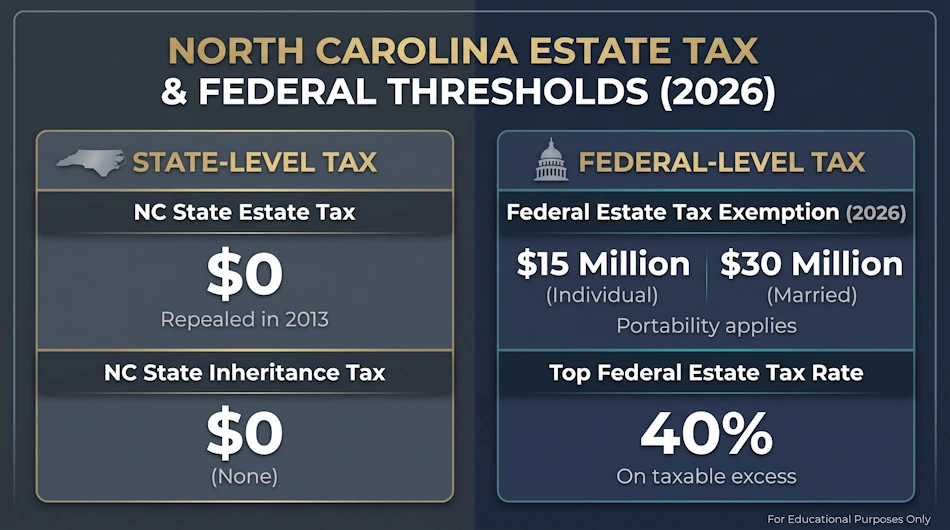
North Carolina families do not pay a state-level estate tax or inheritance tax, as the state fully repealed its estate tax for decedents dying on or after January 1, 2013. However, high-net-worth North Carolina households remain subject to federal estate taxes on assets exceeding the federal basic exclusion amount. Families can legally minimize or avoid federal estate taxes through structured lifetime gifting, irrevocable trusts, portability elections, and coordinated retirement planning strategies.
Understanding North Carolina Estate Tax Laws and Federal Thresholds
North Carolina does not impose a state estate tax or an inheritance tax on beneficiaries. According to the North Carolina General Assembly (S.L. 2013-316), the state estate tax was officially repealed, meaning state-level tax liability on wealth transfers is zero.
Federal estate tax obligations, however, remain a key consideration for larger estates. Under federal guidelines codified by the Internal Revenue Service (IRS Rev. Proc. 2025-32), the basic exclusion amount is $15 million per individual, allowing a married couple to protect up to $30 million when portability is properly elected. Estates valued above these thresholds face a top federal estate tax rate of 40% on the excess amount.
Related article: " High Net Worth Tax Reduction Strategies: How Families Can Stop Tax Drag "
5 Effective Strategies to Minimize Federal Estate Tax Exposure
1. Leverage Irrevocable Trusts for Asset Removal
Placing assets into an irrevocable trust transfers legal ownership out of your personal estate. Because the assets are no longer held individually at death, subsequent growth and appreciation occur outside the taxable gross estate. Common structures include:
- Spousal Lifetime Access Trusts (SLATs): Allows one spouse to fund an irrevocable trust for the benefit of the other spouse, utilizing current lifetime exclusions while retaining indirect access.
- Irrevocable Life Insurance Trusts (ILITs): Removes life insurance death benefits from the taxable estate, preventing policy payouts from triggering the 40% federal tax.
2. Implement Strategic Annual and Lifetime Gifting
According to the IRS, individuals can gift up to $19,000 per recipient per year ($38,000 for married couples splitting gifts) without consuming any of their lifetime exclusion or triggering a Form 709 gift tax return.
Direct payments made on behalf of family members for qualifying tuition or medical expenses are exempt from gift tax calculations entirely, offering an additional avenue for wealth transfer.
3. Coordinate Comprehensive Estate and Retirement Planning
Retirement assets, such as traditional IRAs and 401(k)s, present unique tax considerations because they carry deferred income tax liabilities alongside potential estate tax exposure.
Integrating retirement planning with estate structuring can help prevent double taxation on inherited accounts. Strategic Roth conversions during lower-income retirement years systematically reduce the overall size of the taxable estate while creating tax-free distributions for beneficiaries.

4. Ensure Proper Spousal Portability Elections
A surviving spouse can claim the unused portion of a deceased spouse’s federal exclusion amount - a mechanism known as portability. Portability is not automatic; the estate’s executor must file IRS Form 706 on a timely basis following the first spouse's death, even if no tax is owed. Completing this filing locks in up to $30 million in combined federal exemptions for the family.
5. Utilize Charitable Remainder and Lead Trusts
High-net-worth families with appreciated assets or real estate in North Carolina can transfer these holdings into Charitable Remainder Trusts (CRTs) or Charitable Lead Trusts (CLTs). These structures generate income tax deductions, reduce the gross estate, and support philanthropic goals.
Frequently Asked Questions About NC Estate Planning
Does North Carolina tax inheritance received from another state?
No. North Carolina does not tax beneficiaries on inherited cash, securities, or real estate, regardless of where the deceased resided. However, post-death income earned by inherited assets or distributions from traditional retirement accounts remain subject to standard income tax rules.
How does retirement planning impact estate tax calculations?
Retirement accounts are included in the owner's gross estate for federal estate tax purposes. Comprehensive estate and retirement planning can help balance traditional income tax drawdown strategies with long-term wealth transfer goals, minimizing both income and estate tax burdens for heirs.
Are revocable living trusts effective for avoiding federal estate taxes?
Revocable living trusts are primarily used to avoid the North Carolina probate process, maintain family privacy, and manage assets during incapacity. Because the grantor retains control over a revocable trust, the assets remain part of the taxable gross estate. Irrevocable trust structures are generally required for estate tax reduction.
Retirement Planning in Apex, NC
Preserving multi-generational wealth across the Research Triangle can benefit from a tailored strategy that reflects both federal tax laws and local economic realities. Whether you are managing family real estate in Raleigh, navigating corporate equity packages near Research Triangle Park, or organizing long-term business succession in growing communities like Apex, Cary, and Holly Springs, proactive structuring can help keep your assets within your family. High-net-worth households throughout Wake County can benefit from comprehensive financial planning to align lifetime gifting, trust creation, and wealth transfer mechanisms with their overall financial goals.
Schedule a personalized consult with our Wake County financial planning team today to explore customized wealth preservation strategies for your family.