Financial Blog
Aligning Wealth and Beliefs: How a Financial Adviser Builds Custom Portfolio Screens
Kris Alban | Oct 19 2026 12:00
Investing is no longer purely about financial return; for many individuals, it is equally about personal accountability. A fundamental truth of modern wealth management is that broad ESG (Environmental, Social, and Governance) funds often fall short because they apply generic definitions of ethics that may not reflect individual beliefs. Working directly with a qualified Financial Adviser to construct custom personalized screens allows investors to exclude specific industries, target preferred causes, and maintain a growth strategy tailored to their exact standards.
According to research from the Forum for Sustainable and Responsible Investment, US sustainable investment assets accounted for over 8.4 trillion dollars in total assets managed under site strategies in recent industry evaluations (US SIF Foundation, Report on US Sustainable and Impact Investing Trends , https://www.ussif.org/trends).
Additionally, a study by the Morgan Stanley Institute for Sustainable Investing found that 75 percent of individual investors global-wide express active interest in sustainable investing strategies (Morgan Stanley, Sustainable Signals Whitepaper , https://www.morganstanley.com/content/dam/msdotcom/ideas/sustainable-signals/pdf/Sustainable_Signals_Whitepaper.pdf). These figures highlight a growing demand for portfolios designed around individual preferences rather than one-size-fits-all options.
The Limitations of Off-the-Shelf Sustainable Funds
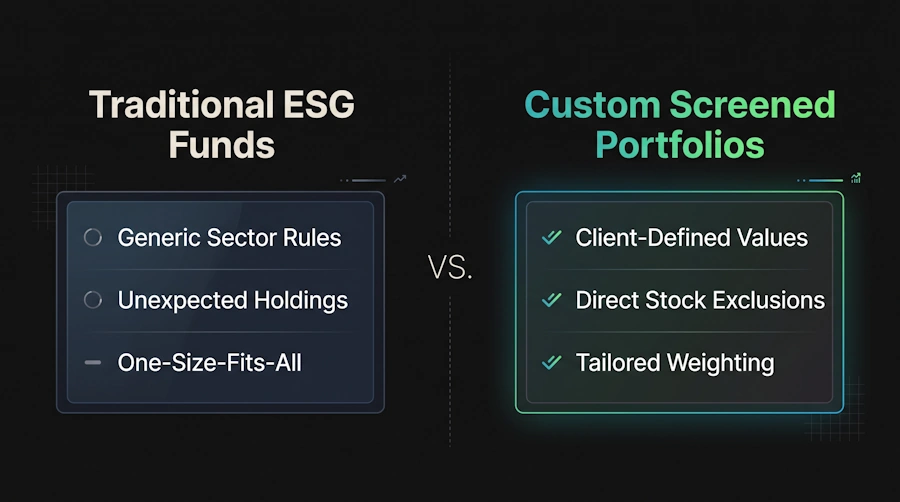
Many investors discover that commercial ethical funds contain companies they prefer to avoid. Standard funds often use broad scoring metrics, which can result in fossil fuel producers or controversial defense contractors appearing in "green" portfolios.
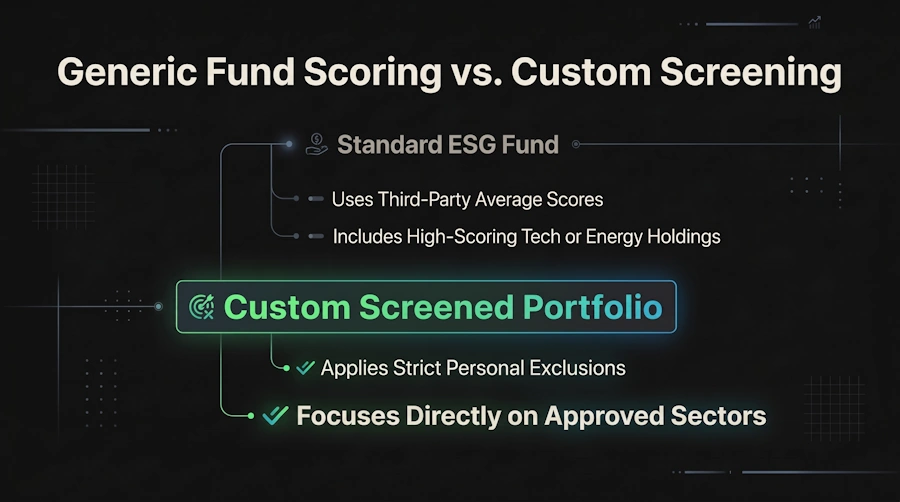
When you consult a financial adviser, you gain access to customized screening capabilities. Rather than relying on generic index providers, an experienced personal financial advisor can work directly with you to outline specific criteria. This customized approach helps bridge the gap between financial objectives and personal principles.
Exploring Different Values-Based Investment Frameworks
Values-based investing is not a single rigid methodology; rather, it encompasses a wide spectrum of personal, ethical, and moral frameworks depending on what matters most to you. For instance, Biblically Responsible Investing (BRI) focuses on screening out corporate activities that conflict with traditional Christian values, such as gambling, alcohol production, or anti-family media. In contrast, Ethical and Social Impact Investing often targets broader societal issues, emphasizing labor standards, human rights, and diversity.
Other specialized frameworks include Halal/Islamic Finance , which strictly avoids interest-bearing debt and impermissible business sectors, as well as Faith-Based or Anti-ESG screens designed to align portfolios with specific religious or free-market doctrines. A knowledgeable Financial Adviser can help you identify which framework aligns with your views or synthesize elements from multiple perspectives to build a truly bespoke screening strategy.
How Custom Portfolio Screening Works
Custom portfolio screening uses technology and direct indexing to filter securities at the individual company level. An experienced financial advisor will often follow a structured process to implement these filters:
- Values Discovery: Identifying core ethical, environmental, or social parameters.
- Negative Screening: Filtering out companies involved in specific activities (such as weapons manufacturing, tobacco, fossil fuels, or animal testing).
- Positive Screening: Overweighting firms with active practices in renewable energy, community development, or fair trade.
- Risk and Return Balancing: Rebalancing the remaining universe of stocks to mirror broader market performance targets while maintaining diversification.
Research published by the NYU Stern Center for Sustainable Business examined over 1,000 studies conducted between 2015 and 2020, revealing that ESG management strategies performed equal to or better than conventional capital allocation in 58 percent of cases (NYU Stern, ESG and Financial Performance , https://www.stern.nyu.edu/experience-stern/about/departments-centers-initiatives/centers-of-research/center-sustainable-business/research/research-initiatives/esg-and-financial-performance).
Frequently Asked Questions
Does custom screening lower potential investment returns?
Empirical evidence indicates that applying ethical filters does not automatically reduce performance. Academic reviews demonstrate that values-aligned strategies frequently achieve market-rate performance over long horizons. A registered Financial Adviser helps construct your portfolio to maintain optimal sector balance and manage risk exposure.
How does a Financial Adviser handle tax implications when setting up screens?
When transitioning existing assets into a custom-screened portfolio, selling capital assets can trigger tax events. A fiduciary financial adviser can utilize strategies like tax-loss harvesting and phased transitions to help manage potential capital gains taxes.
What is the difference between negative screening and positive impact investing?
Negative screening excludes specific companies or sectors based on criteria you wish to avoid. Positive impact investing proactively selects companies driving specific solutions, such as clean water technology or healthcare access. A professional financial adviser can integrate both strategies into a single investment account.
Values-Based Investing Guidance in Cary & Apex
Navigating values-based investing requires a personalized touch that standard, mass-market ESG funds typically cannot deliver. For residents across Cary, Apex, and the broader Research Triangle region, aligning your wealth with your core principles is best achieved alongside a local partner who understands your unique community context and financial aspirations. Whether you are situated in Raleigh or anywhere in Wake County, a fiduciary Financial Adviser can help you craft direct indexing strategies and customized portfolio screens tailored to your exact standards while managing risk and tax efficiency.
Are you ready to align your portfolio with your values? Contact us today to schedule your complimentary review.