
Financial Blog
Nonprofit 401k Setup: A Complete Guide to Retirement Plans and Investment Management
Kris Alban | Oct 12 2026 12:00
Nonprofits with 5 to 200 team members can sponsor a 401(k) plan to attract and retain dedicated staff while maintaining total fiduciary control over organization assets. While public sector and tax-exempt organizations traditionally relied on 403(b) plans, adopting a modern 401(k) structure can give executive leadership access to flexible plan designs, lower administrative costs, and streamlined oversight. Selecting the right retirement structure and institutional investment management strategy helps protect board members from liability while growing staff savings.
Understanding the Difference: Nonprofit 401(k) vs. 403(b) Plans
Many tax-exempt leaders assume 403(b) plans are the required choice for 501(c)(3) organizations. However, tax regulations permit tax-exempt employers to establish standard ERISA 401(k) programs.
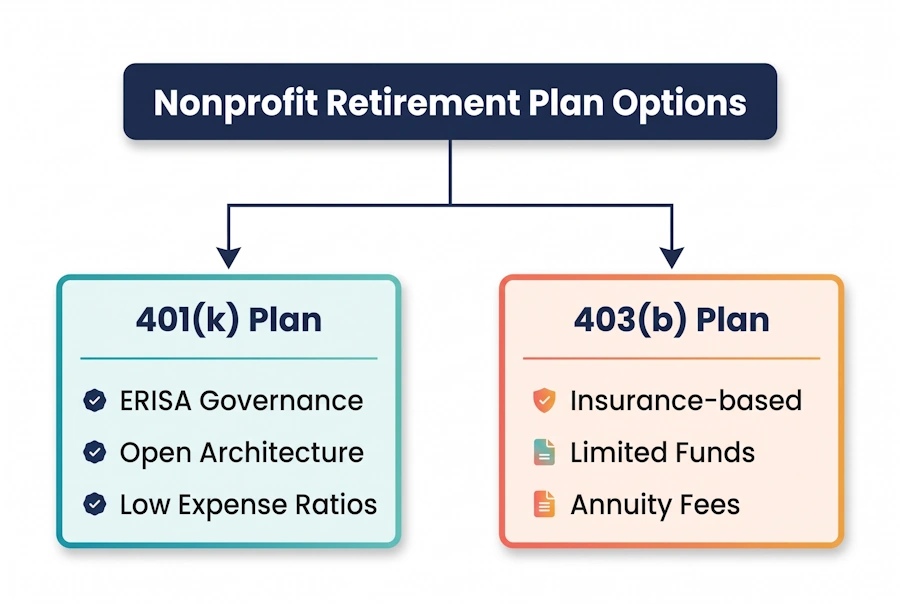
Historical 403(b) plans often rely on individual annuity contracts, which carry higher administrative fees, surrender charges, and limited investment selections. A modern 401(k) platform typically offers open-architecture fund menus, transparent recordkeeping costs, and institutional investment management practices tailored to non-profit budgets.
A major research study by the Center for Retirement Research at Boston College (https://crr.bc.edu/wp-content/uploads/2019/10/IB_19-17.pdf) indicates that administrative fees and fund expense ratios significantly impact long-term participant balance growth over multi-decade careers. Modern 401(k) plans can systematically reduce these internal overhead expenses compared to legacy insurance-based arrangements.
Step-by-Step Nonprofit 401k Setup Process
Setting up an employer-sponsored retirement program requires clear milestones to keep administrative costs predictable and legal compliance intact.
The Role of Investment Management in Protecting Board Fiduciaries
Nonprofit board members and officers owe a strict legal duty to manage organization funds and employee retirement assets with care. Selecting an ERISA investment management framework protects leadership teams while providing structured oversight for both retirement funds and operating reserves.
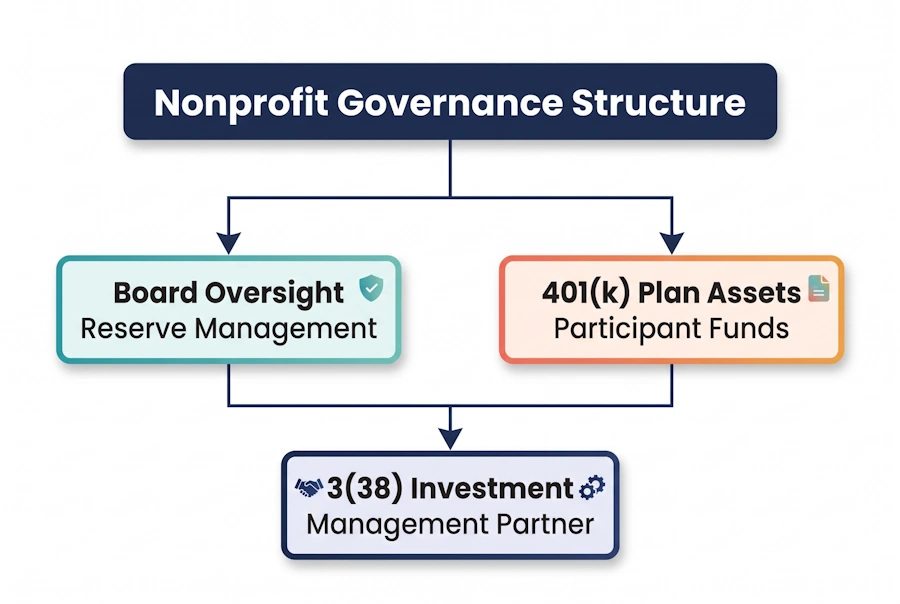
An official report by the U.S. Department of Labor Employee Benefits Security Administration (https://www.dol.gov/agencies/ebsa/about-ebsa/our-activities/resource-center/publications/meeting-your-fiduciary-responsibilities) outlines how employer sponsors must monitor service providers and control plan expenses. Working alongside dedicated investment management experts allows non-profit leaders to maintain compliance with federal guidelines without diverting focus from their primary charitable mission.
Integrating Reserve Funds with Retirement Strategy
Many mid-sized charitable organizations maintain operating reserves, endowments, or capital funds alongside their employee retirement program. Aligning long-term reserve investment management policies with overall organization balance sheets ensures proper liquidity while keeping portfolio costs low.
- Short-Term Reserves: Keep 3 to 6 months of operating cash in high-yield liquid instruments.
- Long-Term Reserves: Apply structured portfolio models aligned with an explicit Investment Policy Statement (IPS) approved by the board.
- Retirement Options: Offer low-cost index funds and target-date options that minimize participant confusion.
Frequently Asked Questions
Can a small 501(c)(3) organization with under 20 employees afford a 401(k) plan?
Yes. Modern digital recordkeepers and fee-only advisors allow small teams to launch a low-cost 401(k) plan without excessive overhead. Tax credits established under federal law can offset a significant portion of plan startup costs for eligible small employers during the initial years of operation.
Why choose a 401(k) over a traditional 403(b)?
While both account types offer pre-tax and Roth savings options, 401(k) plans often feature simpler administrative pricing, fewer hidden insurance fees, and access to independent investment management solutions.
What is the board's liability when offering a 401(k) plan?
Board members act as plan fiduciaries under federal regulations. Delegating discretionary asset choices to an ERISA 3(38) investment management firm helps mitigate personal liability for individual fund performance.
How do administrative fees impact non-profit employee retirement balances?
According to a benchmark study published by the Government Accountability Office (https://www.gao.gov/assets/gao-21-357.pdf), ongoing plan fees reduce total retirement savings over time. Selecting index-based options and transparent fee schedules keeps more capital growing in employee accounts.
Local Non-Profit Retirement and Investment Management Services in the Research Triangle
Navigating retirement plan administration and fiduciary oversight requires a trusted, local partner who understands the unique community landscape of Wake County and the surrounding Triangle region. Based in North Carolina, our team provides tailored non-profit investment management and 401(k) setup solutions for charitable organizations, trade associations, and non-profits across Cary, Apex, Holly Springs, Raleigh, and the greater Research Triangle area.
Whether your organization is a growing local charity in Apex or an established mid-sized non-profit in downtown Raleigh, having face-to-face access to ERISA advisors helps ensure your board remains compliant while your team stays supported. We work directly with local executive directors, finance committees, and board chairs throughout Wake County to reduce administrative burdens, eliminate hidden account fees, and optimize long-term asset growth.
Schedule a Local Fiduciary Plan Review
Ready to evaluate your current retirement program or establish a new 401(k) plan for your Raleigh-area non-profit? Contact our team today
to request a complimentary local plan review and discover how modern investment management strategies can better serve your mission and team.