
Financial Blog
Retirement Planning for Families: A Guide for the Final Years Before Retirement
Kris Alban | Nov 02 2026 13:00
Planning for retirement involves matching your family’s projected annual spending with reliable income sources, tax-advantaged accounts, and investment returns over a 25-to-35-year horizon. For families in their final years of work, retirement readiness is not just about a single savings target; it depends on coordinating your portfolio, health insurance, Social Security filing age, and tax strategy into one unified roadmap.
Recent research highlights how critical this preparation is. According to the Employee Benefit Research Institute (EBRI) Retirement Confidence Survey ( https://www.ebri.org ), while 68% of workers feel confident about having enough money for retirement, fewer than half have completed a comprehensive retirement savings calculation. Furthermore, the Social Security Administration’s actuarial tables ( https://www.ssa.gov ) show that a 65-year-old couple today has an average life expectancy extending well into their mid-80s, with a high likelihood that at least one spouse reaches age 90. Managing income over multiple decades requires careful structure across all areas of household wealth.
Below is a complete look at the ten biggest questions families face as they approach their retirement date.
1. What Age Can We Retire at, and Will We Have Enough Money?
Deciding when to retire starts with determining your household’s baseline spending. Most families find their living expenses change in stages: early active years often see higher travel spending, middle retirement stabilizes, and later years may see higher medical costs.
To determine if your savings can sustain your lifestyle, planners typically examine three core components:
- Guaranteed Income: Predictable income streams such as Social Security benefits, employer pensions, or fixed annuities.
- Portfolio Withdrawal Rate: The annual amount drawn from personal savings. A widely cited benchmark based on historical market data is the 4% guideline, though many families adjust this to 3. 3% to 3. 8% if retiring prior to age 65 to account for a longer horizon.
- Safety Cushion: A cash and short-term reserve covering 1 to 3 years of living expenses to avoid selling stocks during a market downturn.
| Annual Spending Need | Guaranteed Income (Pensions / SS) | Portfolio Gap to Fund | Required Portfolio (at ~3.8% Withdrawal Rate) |
| $80,000 | $30,000 | $50,000 | ~$1,315,000 |
| $110,000 | $40,000 | $70,000 | ~$1,840,000 |
| $140,000 | $45,000 | $95,000 | ~$2,500,000 |
If your total liquid assets cover your portfolio gap at a sustainable distribution rate, an earlier retirement age becomes viable. If a gap remains, working an additional two to three years may provide multiple advantages: it allows more time for potential portfolio growth, provides an opportunity to contribute additional savings, and shortens the overall distribution horizon.
Read also: " How to Know If You Have Enough Money to Retire: A Pre-Retiree Guide "
2. What Accounts Should You Contribute to in the Final Years, and How Much?
In the final years before retirement, many households evaluate tax diversification across three primary account categories:
- Pre-Tax Accounts (Traditional 401(k), 403(b), Traditional IRA): Contributions reduce your taxable income during your peak earning years. Catch-up contributions permit workers aged 50 and older to save above standard annual limits.
- Roth Accounts (Roth 401(k), Roth IRA): Contributions are made with after-tax dollars, but qualified distributions are completely tax-free. If your household is eligible, building up a Roth bucket gives you flexible tax-free cash flow in retirement.
- Health Savings Accounts (HSAs): If enrolled in a high-deductible health plan (HDHP), an HSA offers a triple tax advantage: tax-deductible contributions, tax-free investment growth, and tax-free withdrawals for qualified medical expenses. HSAs can serve as a supplemental healthcare retirement fund.
Families in higher tax brackets often find value in directing maximum contributions to pre-tax plans while working, then utilizing lower-income years post-retirement for strategic Roth conversions.
3. How to Determine Our Withdrawal Sequencing Strategy in Retirement?
The order in which you pull money from your accounts can significantly impact your portfolio's longevity and tax bill. While the optimal strategy is different for every situation, one commonly discussed sequence prioritizes taxable assets first (*though the most suitable order depends heavily on an individual's tax brackets and account balances):
- Taxable Brokerage Accounts First: Selling taxable investments first allows your tax-deferred (Traditional IRAs) and tax-exempt (Roth IRAs) accounts to continue growing unburdened by annual taxes.
- Tax-Deferred Accounts Second: Drawing from Traditional 401(k)s and IRAs up to the top of moderate tax brackets (such as the 12% or 22% federal bracket).
- Tax-Free Roth Accounts Last: Preserving Roth assets allows tax-free compounding for the longest period, providing flexibility for large one-off expenses or leaving an inheritance to heirs.
Read also: " Optimal Retirement Withdrawal Sequencing Strategy: Taming Sequence Risk "
The Proportional or "Bracket-Topping" Approach
Many modern retirement planning strategies depart from the rigid traditional sequence. Drawing exclusively from taxable accounts early can leave you with massive traditional account balances later, resulting in heavy Required Minimum Distributions (RMDs) that push you into higher brackets.
Instead, a proportional withdrawal strategy draws small amounts from taxable, tax-deferred, and tax-free accounts simultaneously, keeping your reported income level and predictable year after year.
4. What Ages Should You File for Social Security?
Choosing when to claim Social Security is one of the most consequential decisions in retirement planning. You can claim benefits as early as age 62, at your Full Retirement Age (FRA, between 66 and 67 depending on birth year), or delay up to age 70.
- Filing at Age 62: Benefits are permanently reduced by up to 30% compared to your FRA benefit.
- Filing at Full Retirement Age (FRA): You receive 100% of your earned Primary Insurance Amount (PIA).
- Filing at Age 70: Benefits earn delayed retirement credits of roughly 8% per year past your FRA, resulting in a benefit up to 24% to 32% larger than at FRA.
For married couples, delaying benefits up to age 70 can increase the monthly benefit amount and may help provide a larger potential survivor benefit, depending on individual health profiles and life expectancy considerations.
5. Should You Be Doing Roth Conversions, and if so, When and How Much?
A Roth conversion involves moving money from a traditional pre-tax IRA or 401(k) into a Roth IRA, paying ordinary income tax on the converted amount in the year of the transfer.
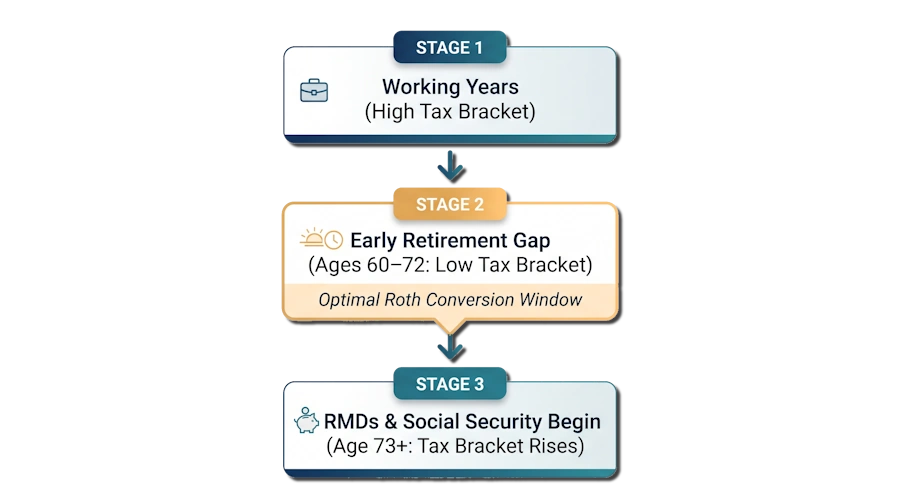
The Ideal Conversion Window
For many households, the years between active employment and the start of RMDs or Social Security represent a potential window to evaluate partial Roth conversions, provided it aligns with their broader tax and healthcare subsidy goals.
Read also: " Roth IRA Conversion Q&A: Your Guide to Smart Retirement Planning "
Determining Conversion Amounts
Rather than converting large sums all at once, partial annual conversions are commonly used to fill lower tax brackets up to their thresholds. For example, a married couple might convert just enough to reach the top edge of the 12% or 22% bracket without crossing into a higher tier. This process reduces future RMD obligations and builds tax-free income for later years.
6. How Can Families Mitigate Taxes Leading Up to and in Retirement?
Tax management in retirement involves proactive coordination rather than simple filing. Families can use several practical methods:
- Asset Location Strategy: Holding tax-inefficient assets (such as high-yield bonds or dividend-generating funds) within tax-deferred or Roth accounts, while placing broad-market index stock funds inside taxable accounts to take advantage of favorable long-term capital gains rates.
- Qualified Charitable Distributions (QCDs): For individuals age 70½ and older, QCDs allow direct transfers of up to $105, 000 annually from a Traditional IRA to an eligible charity. The distribution counts toward RMDs without being included in adjusted gross income.
- Tax-Loss and Tax-Gain Harvesting: In taxable accounts, systematically offsetting realized capital gains with losses, or realizing gains at a 0% federal capital gains rate during low-income retirement years.
- Capitalizing on Itemized Deductions: Bunching charitable donations or medical expenses into specific years to surpass the standard deduction threshold.
Read also: " How to Minimize Capital Gains in Retirement: A Tax-Efficient Guide "
7. What Healthcare Options Exist if You Retire Before 65?
Medicare eligibility begins at age 65. If you evaluate leaving work prior to age 65, establishing a continuous healthcare bridge is an important operational consideration . Families typically choose between four main options:
- COBRA Continuation Coverage: Allows you to stay on your former employer’s group health plan for up to 18 months (or 36 months under specific circumstances). You are responsible for 100% of the premium plus a 2% administrative fee, making it reliable but often costly.
- Affordable Care Act (ACA) Marketplace Plans: Health insurance exchanges offer individual and family policies. Premium tax credits are tied directly to your Modified Adjusted Gross Income (MAGI), not your net worth. Families living off cash savings or taxable account principal can show modest taxable income and qualify for significant premium subsidies.
- Spousal Coverage: If one spouse remains employed, comparing their employer-sponsored plan against individual marketplace options can help identify the more practical balance of cost and coverage.
- Health Care Sharing Ministries: Alternative sharing arrangements exist, though they do not offer guaranteed insurance protections and may exclude pre-existing conditions.
Read also: " How Can You Plan For The Rising Cost of Long‑Term Care? "
8. How Can You Avoid IRMAA (Income-Related Monthly Adjustment Amount)?
IRMAA is a surcharge added to your standard Medicare Part B (medical insurance) and Part D (prescription drug coverage) monthly premiums if your income exceeds specific statutory limits.
The Centers for Medicare & Medicaid Services (CMS) calculates IRMAA using your tax return from two years prior. For example, your 2026 Medicare premiums are determined by the MAGI reported on your 2024 tax filing.
Read also: " How to Avoid Medicare IRMAA: Tax Strategies for Retirees "
Steps to Manage IRMAA Risk
- Watch the "Cliff" Brackets: Unlike marginal income tax brackets, exceeding an IRMAA threshold by a single dollar triggers the full surcharge for the entire year for both spouses.
- Schedule Roth Conversions Early: Complete larger conversions before age 63 so the resulting taxable income does not influence your age 65 Medicare premiums.
- File Form SSA-44 for Life-Changing Events: If your income drops due to a qualifying event—such as retiring or reducing work hours—you can appeal the IRMAA determination using Social Security Form SSA-44, requesting that premiums be based on your current, lower income rather than your past earnings.
9. Are Your Investment Accounts Positioned Appropriately for This Stage?
In the final years before retirement, your portfolio faces a unique risk known as sequence of returns risk . A major market downturn occurring immediately before or during the first few years of distributions can deplete capital faster than a regular recovery allows.
A structured framework to address this is the Three-Bucket Approach :
- Bucket 1: Cash Reserves (Years 1 to 2): High-yield savings accounts, money market funds, or short-term Treasury bills covering 12 to 24 months of living expenses. This fund provides peace of mind and prevents forced selling during downturns.
- Bucket 2: Conservative Income (Years 3 to 7): Short- to intermediate-term bonds, certificates of deposit (CDs), and dividend-paying assets designed to replenish Bucket 1 periodically.
- Bucket 3: Long-Term Growth (Years 8+): Broad-market domestic and international equities. Historically, broad-market equities have offered the growth potential to help hedge against long-term inflation, though they remain subject to market volatility.
Guiding Your Family Toward a Confident Transition
For families living in Apex , Cary , Holly Springs , and across Wake County , retirement planning comes down to connecting all these moving pieces into a single, coordinated roadmap. Whether you want to evaluate early healthcare options, understand how North Carolina tax guidelines apply to your income, or decide on a sustainable withdrawal strategy from your accounts, taking the time to review your options before leaving the workforce can help bring clarity to your next chapter. Learn more about Retirement Planning in Wake County.
If you are within a few years of stepping away from work, Get Started today with a retirement readiness review and talk through the choices that fit your household's goals.