
Financial Blog
Optimal Retirement Withdrawal Sequencing Strategy: Taming Sequence Risk and IRMAA
Kris Alban | Sep 21 2026 12:00
Managing wealth during the accumulation phase relies on a simple rule: maximize growth. Transitioning into the decumulation phase flips that dynamic completely. For pre-retirees between ages 55 and 65, the primary objective shifts toward structured distribution.
A well-executed retirement withdrawal sequencing strategy coordinates income across taxable, tax-deferred, and tax-free accounts. This approach helps mitigate sequence of returns risk, manage lifetime tax liability, and prevent Medicare Income-Related Monthly Adjustment Amount (IRMAA) surcharges. Proper execution can extend portfolio longevity while preserving wealth for future years. Retirement Planning requires aligning these distribution choices to avoid liquidating equities during market downturns.
What Is Sequence of Returns Risk in Retirement Planning?
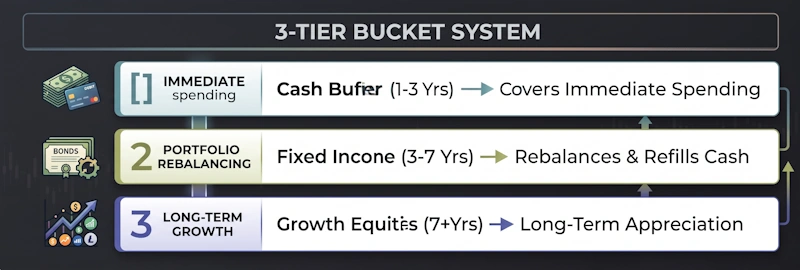
Sequence of returns risk refers to the danger that market declines early in retirement can permanently damage a portfolio's ability to generate income. During accumulation, market dips allow investors to purchase shares at lower prices. When taking regular withdrawals, market drops force the sale of more shares to cover baseline living costs.
Those liquidated shares cannot participate in subsequent market recoveries. The order in which investment returns occur - rather than long-term average returns - exerts a significant influence on overall outcomes once withdrawals begin. Retirement Planning during the five years leading up to retirement and the first five years after (often called the "Fragile Decade") aims to protect capital against early drawdowns.
According to research published by the Journal of Financial Planning, a portfolio subjected to negative returns during the first three years of withdrawals carries a significantly higher probability of early depletion compared to a portfolio experiencing identical negative returns a decade later (www.financialplanningassociation.org/learning/publications/journal).
How IRMAA Surcharges Impact Your Retirement Plan
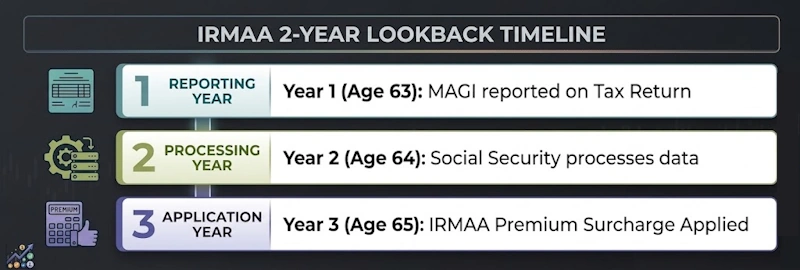
The Income-Related Monthly Adjustment Amount (IRMAA) is a surcharge added to Medicare Part B and Part D premiums for higher earners. Social Security determines IRMAA eligibility using Modified Adjusted Gross Income (MAGI) from tax returns filed two years prior. For example, 2024 income establishes 2026 Medicare premium rates.
Learn more about IRMAA and how to avoid it: " How to Avoid Medicare IRMAA: Tax Strategies for Retirees "
Unlike progressive tax brackets where higher marginal rates apply only to income above a threshold, IRMAA thresholds act as strict "cliff" limits. Crossing a threshold by a single dollar triggers the full surcharge tier across all twelve months of Medicare coverage.
Data from the Centers for Medicare & Medicaid Services shows that crossing an IRMAA cliff can increase individual Part B and Part D annual healthcare costs by hundreds to thousands of dollars per person (www.cms.gov).
| Single Filing MAGI Threshold | Married Filing Jointly MAGI | Est. Annual Combined Surcharge (Per Person) |
| Tier 1: $109,000 or less | $218,000 or less | $0 |
| Tier 2: $109,001 – $137,000 | $218,001 – $274,000 | ~$1,148 |
| Tier 3: $137,001 – $171,000 | $274,001 – $342,000 | ~$2,884 |
| Tier 4: $171,001 – $205,000 | $342,001 – $410,000 | ~$4,620 |
Source: Estimates derived from CMS Medicare Premium Guidelines. Thresholds adjust annually for inflation.
Uncoordinated distributions from traditional IRAs or 401(k) accounts increase MAGI. This can push pre-retirees into higher IRMAA brackets and inadvertently raise their healthcare costs. Incorporating tax-efficient distribution strategies into Retirement Planning helps keep income below these cliffs.
Core Strategies for a Tax-Efficient Withdrawal Sequence
An effective withdrawal hierarchy helps balance tax mitigation, income generation, and market protection.
1. The Pro-Rata & Tax-Bracket Filling Approach
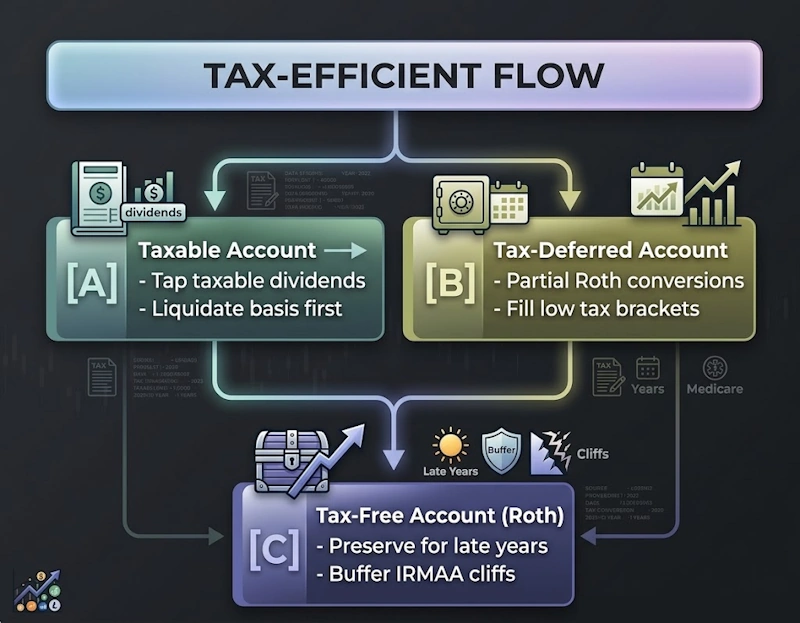
The traditional rule of thumb suggested liquidating taxable accounts first, tax-deferred accounts second, and tax-free Roth accounts last. Modern Retirement Planning often uses a dynamic proportional strategy instead:
- Fill Lower Tax Brackets: Withdraw from traditional IRAs up to the top edge of lower income tax brackets (such as the 10% or 12% brackets).
- Supplement with Taxable Capital: Draw remaining cash needs from taxable brokerages, focusing on assets with high cost basis to limit capital gains.
- Preserve Roth Assets: Reserve Roth accounts to fund unexpected expenses or manage income near IRMAA cliff edges without adding to taxable income.
2. Systematic Partial Roth Conversions
Between career retirement (e.g., age 60) and the onset of Required Minimum Distributions (RMDs at age 73 or 75), income often drops temporarily. This window provides an opportunity for systematic partial Roth conversions:
- Move funds from pre-tax accounts into Roth accounts while in lower income brackets.
- Reduce the total pre-tax balance subject to future RMDs, lowering forced taxable income later in life.
- Plan conversions two years before age 65 (at age 63) to keep MAGI below initial IRMAA thresholds.
Studies from the Society of Actuaries indicate that multi-year Roth conversion strategies during low-income gaps can increase post-tax retirement portfolio longevity by several years while reducing lifetime tax expenses (www.soa.org).
Learn more about Roth Conversions: " Roth IRA Conversion Q&A: Your Guide to Smart Retirement Planning "
Frequently Asked Questions
How does liquidating assets in a market downturn trigger sequence risk?
Selling equities during a downturn locks in capital losses. Because fewer shares remain in the portfolio, subsequent market gains yield smaller absolute dollar returns, accelerating capital depletion over time.
Can Roth conversions increase Medicare IRMAA premiums?
Yes. Roth conversions count toward taxable income and increase MAGI. Conversions completed at age 63 or later can trigger IRMAA surcharges two years later when Medicare Part B and D coverage begins.
What is a cash buffer strategy, and how large should it be?
A cash buffer holds 1 to 3 years of living expenses in high-yield savings, money market accounts, or short-term Treasuries. During market drawdowns, living costs are drawn from this buffer, giving equity investments time to recover without requiring forced liquidations.
Proactive Steps for Retirement Planning
Evaluating distribution sequences early helps identify tax risks and portfolio vulnerabilities before withdrawals begin.
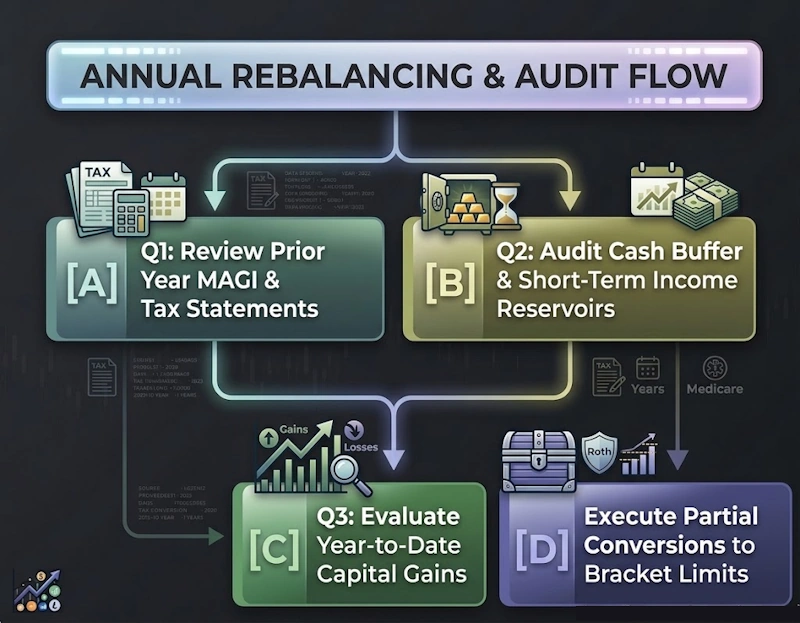
- Conduct a Multi-Year Tax Projection: Map expected taxable distributions, pension payments, and Social Security income from current age through age 75.
- Establish a Cash and Short-Term Buffer: Maintain 12 to 36 months of baseline living expenses in liquid accounts to shield equity positions during market dips.
- Review IRMAA Cliff Distances: Calculate distance from primary IRMAA brackets before executing year-end Roth conversions or capital gain realizations.
- Consult Financial and Tax Professionals: Coordinate with fiduciaries and CPAs to customize a withdrawal framework suited to your specific asset mix and income goals.
Navigating Your Retirement Journey in Wake County
Transitioning into decumulation requires more than general investment advice - it demands a localized, coordinated approach to lifetime tax liability and healthcare costs. As fiduciaries and experienced financial advisers, our team specializes in comprehensive retirement planning designed to protect pre-retirees from sequence of returns risk and high Medicare IRMAA surcharges.
Whether you reside in Apex, Cary, Holly Springs, or the surrounding Wake County communities, we invite you to sit down with us for a personalized distribution review. Located right in the heart of historic downtown Apex on Hunter Street, our office offers a welcoming space to discuss your long-term income strategy over a cup of coffee. Contact us today to schedule your consultation and build a clear path toward a tax-efficient retirement, or learn more about BSG Advisers here.