
Financial Blog
High Net Worth Tax Reduction Strategies: How Families Can Stop Tax Drag
Kris Alban | Aug 03 2026 12:00
High net worth families can often reduce their annual tax liability by restructuring cash positions, optimizing asset location, and utilizing private wealth management frameworks to eliminate unnecessary income drag.
Many affluent households mistakenly believe that high tax bills are simply an unavoidable consequence of earning a high income. In reality, a significant portion of an annual tax bill often stems from structural inefficiencies within brokerage accounts, unmanaged cash reserves, and suboptimal portfolio design.
For high-earning families, targeted Wealth Management strategies can help lower lifetime tax burdens while protecting family wealth across generations.
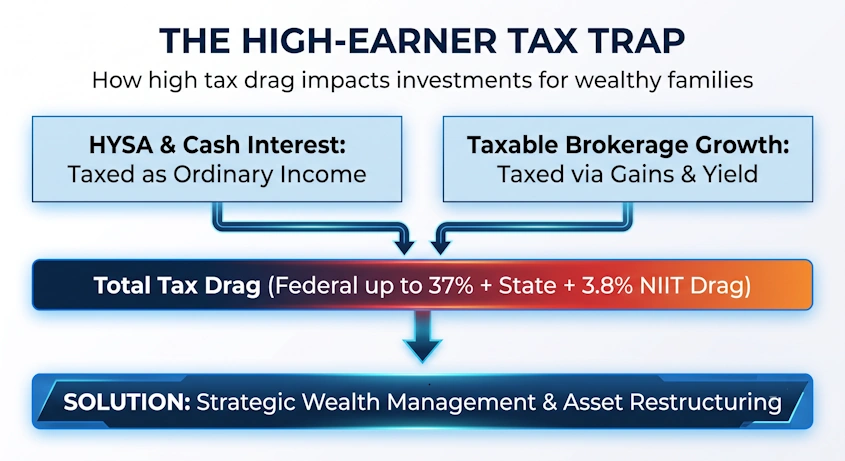
The Hidden Cost of Cash: High-Yield Savings Accounts
High-Yield Savings Accounts (HYSAs) appear safe, but for families in top federal tax brackets, cash interest creates a notable tax burden.
Interest income from cash and standard bank deposits is taxed as ordinary income. A household in the 37% federal bracket paying North Carolina’s 3.99% flat income tax faces a combined tax rate over 40% on interest yield.
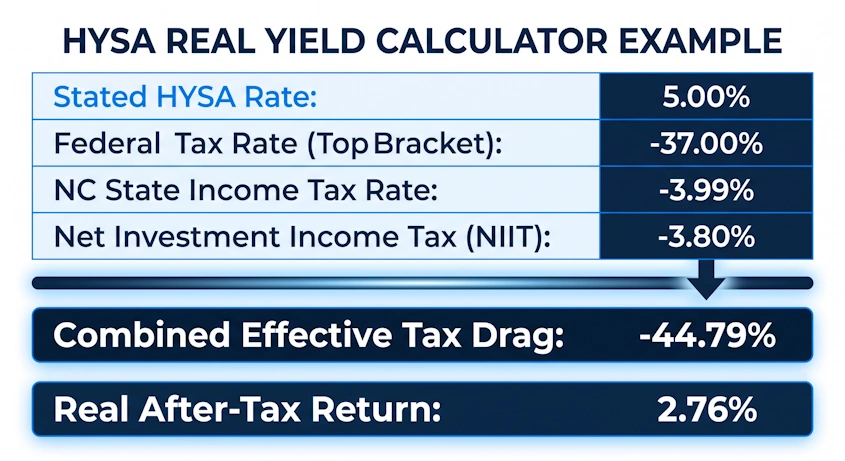
When high-yielding savings accounts generate tens of thousands of dollars in annual interest, nearly half of those gains go directly to federal and state tax authorities. Comprehensive Wealth Management evaluates municipal bond strategies, short-term Treasury structures, and tax-exempt cash alternatives to keep liquid reserves working efficiently.
According to research from the Federal Reserve Bank of St. Louis , liquid assets held in standard deposit accounts frequently experience negative real rates of return once inflation and top-tier marginal income taxes are accounted for (stlouisfed.org).
Tax Drag in Taxable Investment Accounts
Unstructured taxable brokerage accounts often generate preventable tax bills through three main channels:
- Unmanaged Mutual Fund Distributions: Standard active mutual funds frequently pass capital gains distributions to fundholders at year-end, even if the underlying portfolio owner never sold a single share.
- Non-Qualified Dividend Yields: High dividend payments taxed as ordinary income compound tax costs year over year.
- Frequent Trading and Turnover: Short-term trades realized within a taxable account trigger short-term capital gains, which are taxed at high ordinary income rates rather than lower long-term rates.
Working with specialized Wealth Management professionals can help transition families away from high-turnover investments toward tax-managed Indexing, direct indexing, and custom Exchange-Traded Funds (ETFs) that minimize taxable events.
Strategic Asset Location: What Belongs Where
Asset allocation determines how money is divided among stocks, bonds, and real estate. Asset location determines which specific account type holds each investment.
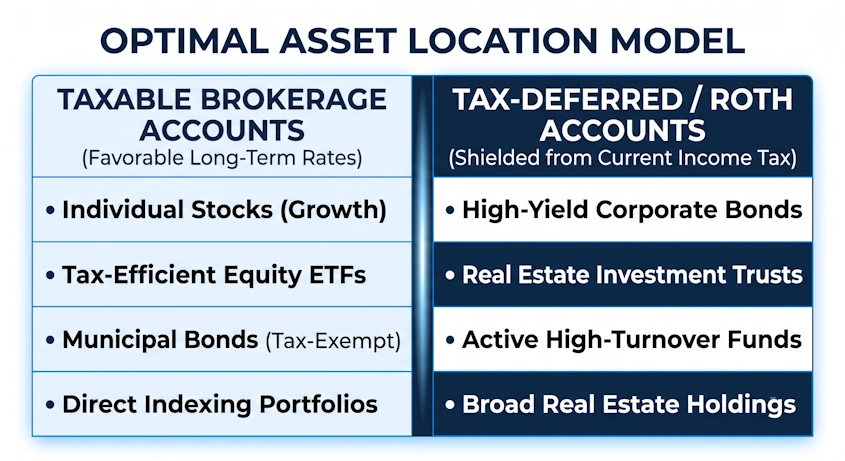
Proper asset location can lower annual tax liabilities without altering overall risk profiles. By placing tax-inefficient assets into tax-sheltered structures and holding growth assets in taxable accounts to capture long-term capital gains rates, families retain a larger portion of their growth.
A landmark study published by the Journal of Financial Planning showed that active asset location strategies can add up to 0.75% in annual after-tax net returns for high-income investors (financialplanningassociation.org).
4 Core High Net Worth Tax Reduction Strategies
For high-income households looking to optimize their overall balance sheet, these core strategies offer structured opportunities to reduce tax drag.
1. Direct Indexing and Year-Round Tax-Loss Harvesting
Unlike standard index funds, direct indexing allows an investor to own individual stocks within an index. When individual equities within the index decline, those specific losses can be harvested to offset capital gains elsewhere in the portfolio while preserving long-term equity exposure.
2. Tax-Exempt Municipal Bond Allocations
For high earners in North Carolina, municipal bonds issued by state and local governments offer interest income that is generally exempt from federal and NC state income taxes. Evaluating tax-equivalent yields helps ensure fixed-income portfolios deliver maximum after-tax cash flow.
3. Family-Focused Estate and Trust Planning
Coordinating trusts, gifting strategies, and legacy structures helps prevent unnecessary estate and wealth transfer taxes over time. Integrating Wealth Management with experienced trust planning preserves family wealth across generations.
4. Maximizing Philanthropic Tax Deductions
Utilizing Donor-Advised Funds (DAFs) or direct donations of appreciated long-term securities allows families to avoid paying capital gains tax on the appreciation while claiming a charitable tax deduction.
The Internal Revenue Service (IRS) provides guidance on charitable contribution limits and appreciated asset transfers to help high-earning taxpayers structure gifts effectively (irs.gov).
Frequently Asked Questions
Why is my high-yield savings account costing me so much in taxes?
Interest earned from a High-Yield Savings Account is treated as ordinary income by federal and state tax authorities. For families in top federal tax brackets, federal taxes, state income taxes, and net investment income taxes can take a large percentage of those earnings each year.
What is the difference between tax deduction and tax drag?
Tax deductions lower current taxable income. Tax drag refers to the ongoing reduction in portfolio growth caused by annual taxes on dividends, interest, and realized capital gains within investment accounts.
How does wealth management reduce annual tax exposure?
Professional Wealth Management evaluates an entire portfolio structure to implement tax-loss harvesting, reallocate tax-inefficient assets, transition cash into tax-advantaged alternatives, and construct customized portfolios designed to limit taxable distributions.
Schedule Your Personal Wealth and Tax Audit
Tax drag quietely erodes wealth over time, but structural adjustments can protect your hard-earned assets.
If your family holds significant balances in taxable brokerage accounts or high-yield cash reserves, a proactive review can identify clear opportunities to reduce your overall tax load.
Contact our team today to schedule a comprehensive Wealth Management review designed for high-net-worth families in North Carolina.