
Financial Blog
NC Trust Income Tax Post-Kaestner: Using Directed Trusts to Protect Family Wealth
Kris Alban | Nov 16 2026 13:00
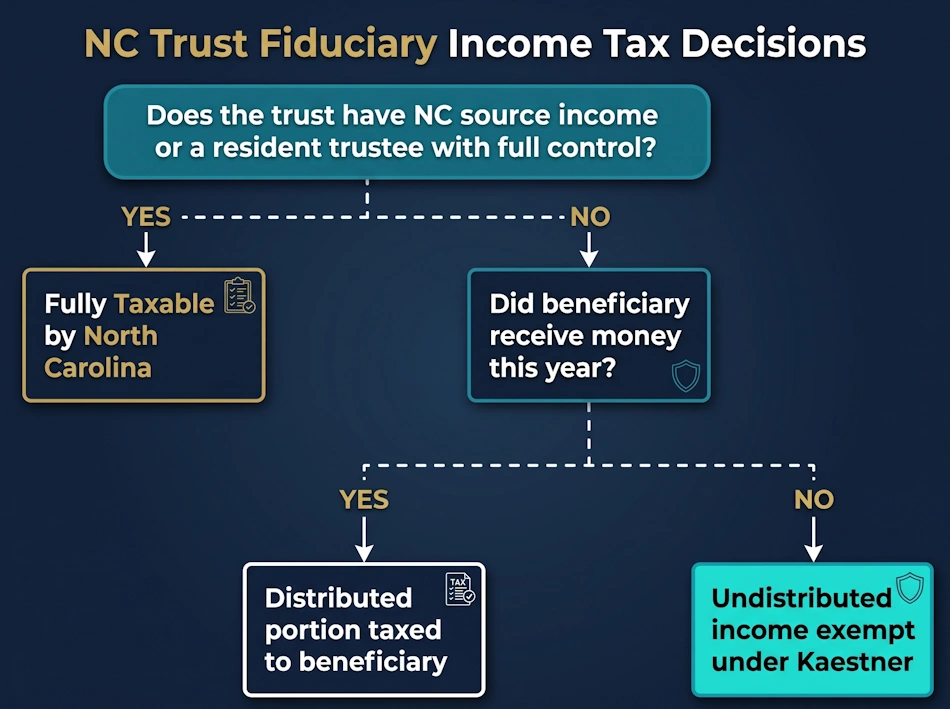
Under North Carolina law, an out-of-state trust is not subject to state income tax solely because a beneficiary lives in North Carolina, provided the beneficiary does not have an absolute right to withdraw or demand the funds. In the landmark decision North Carolina Department of Revenue v. Kimberley Rice Kaestner 1992 Family Trust , the Supreme Court of the United States determined that the state cannot tax undistributed trust income if the beneficiary’s receipt of funds remains uncertain and discretionary. For high-net-worth families, collaborating with legal counsel to situs a directed trust in an appropriate jurisdiction may help mitigate potential multi-state tax exposure, while allowing portfolio management to remain with an independent financial adviser.
Understanding NC Trust Income Taxation Post-Kaestner
State income taxation of irrevocable trusts often creates confusion for multigenerational families. Under North Carolina General Statutes § 105-160.2, the state assesses a fiduciary income tax on taxable income that is held for the benefit of a North Carolina resident. For years, the North Carolina Department of Revenue maintained that having a resident beneficiary in the state was sufficient reason to levy taxes on all trust income.
The Supreme Court rejected that position. In North Carolina Department of Revenue v. Kimberley Rice Kaestner 1992 Family Trust , 139 S. Ct. 2213 (2019), the Court held that the Due Process Clause of the Fourteenth Amendment prohibits a state from taxing trust income when the state's sole connection is an in-state resident beneficiary who receives no distributions and has no guaranteed right to demand funds.
The ruling established that three specific factors protect undistributed trust income from state taxation:
- The trust income has not been distributed to the in-state beneficiary.
- The resident beneficiary has no legal right to demand the income or principal.
- The beneficiary is not certain to receive the accumulated income in the future.
For families across North Carolina, this legal precedent provides important framework considerations regarding when accumulated, undistributed trust income may avoid North Carolina fiduciary income tax liability.
When Does North Carolina Still Tax Out-of-State Trusts?
While the Kaestner ruling limits state overreach, it does not provide an automatic pass. North Carolina still seeks to collect taxes on trust income whenever specific nexus triggers exist:
- Direct Distributions: When an out-of-state trust distributes income to a resident beneficiary, that income becomes taxable on the resident's personal North Carolina tax return.
- North Carolina Source Income: Any trust that generates revenue from real property, tangible personal property, or active business operations located within North Carolina remains subject to state tax liability.
- In-State Resident Fiduciaries: If the individual serving as the trustee resides in North Carolina, the state may assert tax jurisdiction over the entire trust administration.
- Vested Rights of Withdrawal: If the trust agreement grants an in-state beneficiary an outright right of withdrawal (such as general power of appointment or standard age milestones that have passed), the state treats those assets as taxable to the beneficiary.
Because state nexus rules involve nuanced legal standards, working alongside qualified estate counsel and a knowledgeable financial adviser can assist family fiduciaries in evaluating activities that might trigger an in-state tax presence.
Why Families Choose Directed Trusts in Tax-Advantaged States
To retain the tax efficiencies confirmed in Kaestner , families often work with estate planning attorneys to situs trusts in states that do not impose fiduciary income taxes, such as Delaware, South Dakota, Nevada, or Wyoming.
However, placing a trust out of state under a traditional trustee model presents a challenge: institutional trust companies often demand full control over portfolio investments. High-net-worth families frequently find this arrangement undesirable, as corporate trust departments may utilize rigid asset allocation models or high internal fee schedules.
In many circumstances, a directed trust structure offers a potential framework to consider. Under a directed trust statute:
- The Directed Trustee: An institutional trust company based in a state like Delaware or South Dakota handles fiduciary administration, trust accounting, and custody.
- The Distribution Advisor: A designated individual or committee determines whether and when discretionary distributions should be made to beneficiaries.
- The Investment Director: A qualified financial adviser or investment professional directs all investment decisions, asset management strategies, and portfolio allocations.
By separating administrative functions from investment oversight under applicable state statutes, a family can seek to establish administrative situs in a favorable jurisdiction while retaining a customized investment strategy coordinated by an experienced financial adviser.
The Role of an Investment Director in Directed Trust Asset Management
When an advisory firm serves as the Investment Director, families can retain tailored investment management rather than defaulting to an out-of-state corporate trustee's proprietary models.
The Investment Director assumes fiduciary responsibility specifically for:
- Designing customized investment policy statements tailored to multi-generational goals.
- Selecting diversified global equity, fixed income, and alternative asset allocations.
- Implementing tax-efficient strategies such as tax-loss harvesting, asset location, and manager due diligence.
- Communicating directly with the administrative trustee to satisfy annual liquidity needs.
This clear division of labor allows each professional to focus on their core expertise. The estate attorney drafts protective, discretionary language; the administrative trustee maintains the out-of-state situs; and your financial adviser works within the parameters established by trust counsel, managing the portfolio in accordance with the trust's investment objectives.
Multi-State Trust Taxation: Jurisdiction Comparison
Different trust jurisdictions offer distinct advantages regarding state income tax, asset protection, and statutory trust duration. Below is a comparison of premier directed trust jurisdictions frequently utilized by North Carolina families:
| State | State Income Tax on Non-Resident Beneficiary Trusts | Directed Trust Statute | Rule Against Perpetuities (Trust Duration) | Statutory Asset Protection Period |
| Delaware | 0% on accumulated income for out-of-state beneficiaries | Yes (12 Del. C. § 3313) | Perpetual (Personal property) | 4 years |
| South Dakota | 0% (No state income tax) | Yes (SDCL § 55-1B) | Perpetual (No limitation) | 2 years |
| Nevada | 0% (No state income tax) | Yes (NRS § 163.553) | Up to 365 years | 2 years |
| Wyoming | 0% (No state income tax) | Yes (Wyo. Stat. § 4-10-710) | Up to 1,000 years | 2 years |
| North Carolina | Up to 4.5% (subject to statutory phase-downs) | Limited / Traditional | Uniform Statutory (90 years) | Standard fraudulent transfer rules |
Selecting the ideal jurisdiction requires evaluating not only tax rates, but also privacy protections, court systems (such as Delaware's Court of Chancery), and transfer rules. A skilled financial adviser collaborates directly with your trust counsel to assess which state environment best supports your family's financial roadmap.
Related reading: " How to Avoid Estate Tax in North Carolina: Wealth Protection Strategies "
Documented Research on Fiduciary Tax Savings
The economic impact of proper fiduciary tax planning is substantial. According to research published by the American College of Trust and Estate Counsel (ACTEC), fiduciary income tax rates reach the top federal tax bracket at much lower income thresholds than individual returns. In fact, federal tax brackets reach the maximum 37% rate on trust income at just $15, 650 of accumulated earnings, compared to over $600, 000 for married couples filing jointly.
When state taxes are added to that burden, the compounding drag over decades can diminish family wealth. For further details on how state statutes apply to non-resident fiduciaries, review the comprehensive analysis from the American College of Trust and Estate Counsel (https://actecfoundation.org/wp-content/uploads/The-Kaestner-Trust-Case-Due-Process-and-State-Taxation-of-Non-resident-Trustees.pdf) .
Additional legal perspectives highlighted by Williams Mullen Legal News explain how the Kaestner ruling reshaped modern estate planning (https://www.williamsmullen.com/insights/news/legal-news/scotus-finds-application-north-carolinas-trust-income-tax-unconstitutional). Furthermore, a detailed review of state tax limitations provided by Loeb & Loeb LLP Publications underlines the importance of maintaining purely discretionary trust language to avoid accidental state tax liability (https://www.loeb.com/en/insights/publications/2019/06/supreme-court-holds-north-carolina-trust-tax-law-unconstitutional).
Strategic Steps for Navigating NC Trust Income Taxation Post-Kaestner
Managing an irrevocable trust under modern tax rules involves deliberate coordination across legal and financial teams. The following four considerations serve as a starting point when reviewing fiduciary structures with your professional team:
- Conduct a Trust Inventory: Have your estate planning attorney review all existing trust agreements to determine whether beneficiaries hold mandatory withdrawal rights or general powers of appointment that could compromise tax neutrality.
- Review Distribution Patterns: Evaluate the timing and necessity of discretionary distributions. Whenever principal or income leaves the trust and enters the personal bank account of a North Carolina beneficiary, it will generally become subject to individual state taxation.
- Decant or Modify the Trust Siting: If an existing trust is trapped in a restrictive or tax-heavy jurisdiction, consult trust counsel to examine statutory decanting or trust modification to move its situs to a state like Delaware or South Dakota.
- Appoint an Independent Investment Director: Work with a financial adviser who understands directed trust fiduciaries. Establishing your wealth manager in the role of Investment Director allows you to maintain a customized investment approach while coordinating with trust counsel to respect the administrative boundaries of the chosen jurisdiction.
Frequently Asked Questions About NC Trust Income Taxation Post-Kaestner
Does the Kaestner ruling mean North Carolina residents never pay tax on trust money?
No. The Supreme Court ruling in Kaestner protects only undistributed income held inside an out-of-state trust where the beneficiary has no guaranteed right to demand payment. Once the trustee exercises discretion and pays out income directly to a North Carolina resident, that distributed income must be reported on the resident's state return.
Can our family move an existing North Carolina trust to an out-of-state directed trust?
In many cases, yes. Depending on the trust terms and state statutes, trust counsel can often decant or petition the court to transfer trust administration to an out-of-state institutional trustee in jurisdictions like Delaware or South Dakota. Your estate planning attorney and financial adviser can evaluate the trust agreement to explore available options.
What is the primary difference between a traditional trust and a directed trust?
In a traditional trust, a single trustee oversees both administration and investment management. In a directed trust, those duties are formally unbundled. An institutional trustee in a low-tax state manages administrative duties, while an external Investment Director, typically your chosen financial adviser, handles portfolio management and asset allocation.
Will having an Investment Director located in North Carolina trigger NC trust tax?
Generally, no, provided the trust documents and state statutes are followed carefully. Because an Investment Director merely directs trading in a non-discretionary or fiduciary capacity for investments without having custody of the assets or discretion over distributions to beneficiaries, primary trust administration remains anchored with the out-of-state corporate trustee. Always verify the governing statute with legal counsel.
Protecting Your Multigenerational Legacy in Wake County
Navigating the complexities of NC trust income taxation post-Kaestner requires close collaboration between legal and wealth management professionals. Families throughout Apex, Cary, Holly Springs, and the wider Wake County area have worked hard to build lasting legacies, and evaluating these planning opportunities does not mean settling for impersonal, one-size-fits-all portfolio management. As financial advisers serving our local Triangle community, we regularly collaborate with estate planning attorneys when families explore directed trust structures. We help design investment portfolios tailored to your long-term financial plan while coordinating closely with legal counsel regarding multi-state trust parameters. Contact our Apex office today to schedule a confidential discussion with our team.