Financial Blog
Small Business 401k Plan Design: How Business Owners Maximize Savings and Lower Taxes
Kris Alban | Aug 10 2026 12:00
A properly structured 401(k) plan allows small business owners to maximize personal retirement savings while keeping company costs predictable. Designing a plan requires balancing employer contribution levels, employee eligibility rules, and tax-deferred growth strategies.
Small business owners can customize their plan features - including matching rates, profit-sharing formulas, 401(k) loans, and after-tax contribution options - to meet both owner goals and staff retention needs. Consulting a qualified Investment Adviser can help ensure the selected plan features align with federal compliance guidelines, such as ERISA rules maintained by the U.S. Department of Labor.
Click here to read " How to Start a 401k for My Business: A Simple 4-Step Guide "
1. Setting Eligibility Criteria: Age and Length of Service
Small business owners can set eligibility rules to control plan administration costs while keeping the plan accessible to long-term employees. Under federal guidelines set by the IRS, plans may require employees to complete up to one year of service and reach age 21 before entering the plan.
Setting eligibility criteria helps manage company expenses:
- One Year of Service: Filters out short-term turnover so match contributions apply primarily to retained staff.
- Age 21 Requirement: Aligns with standard federal minimums while keeping recordkeeping simple.
2. Employer Match vs. Profit Sharing Design
Employers can structure corporate contributions using matching funds, profit sharing, or a combination of both.
Matching Formulas
A company match provides contributions based on employee deferrals. A standard Safe Harbor match structure (such as 100% on the first 3% of pay and 50% on the next 2%) helps traditional plans automatically pass annual IRS nondiscrimination tests.
Profit Sharing Options
Profit sharing gives owners flexibility because contributions remain discretionary each year.
- Pro-Rata Allocation: Distributes contributions as a uniform percentage of pay across all participants.
- Cross-Tested (New Comparability) Design: Groups employees by job classification, age, or service length. This allows business owners to direct higher allocation percentages to key employees or older business owners while meeting IRS minimum gateway requirements for rank-and-file staff.
Working with an Investment Adviser allows business owners to model different profit-sharing formulas to see how allocations impact both tax savings and employee rewards.
Click here to read " Is a 401(k) Plan Right for Your Small Business? "
3. Advanced Savings: The Mega Backdoor Roth Option
For business owners seeking maximum tax-free growth, adding an after-tax contribution feature alongside an in-plan Roth conversion enables the "Mega Backdoor Roth" strategy.
This feature allows total contributions (employee deferrals, employer match/profit sharing, and voluntary after-tax contributions) to reach the annual IRS overall limit.
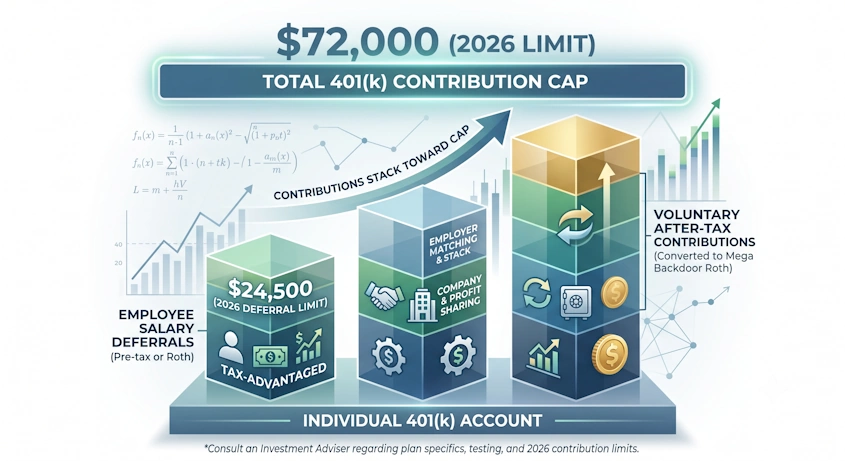
Compliance Note: Voluntary after-tax contributions are subject to Actual Contribution Percentage (ACP) testing. An Investment Adviser can review whether a company's demographics support after-tax contributions without triggering test failures.
4. Including 401(k) Loan Provisions
Allowing participants to take loans against their account balance can increase plan participation.
- IRS Loan Limits: Participants can borrow up to 50% of their vested account balance or $50,000, whichever is less.
- Repayment: Loans are repaid through payroll deductions over a period of up to five years.
- Considerations for Owners: While loans offer liquidity, delinquent payments create taxable distributions.
5. Frequently Asked Questions (FAQ)
Can a business owner contribute more to their own account than employees?
Yes, using safe harbor matching or cross-tested profit-sharing formulas allows higher contributions for owners while remaining fully compliant with IRS non-discrimination rules.
How does an Investment Adviser help with plan design?
An Investment Adviser helps select appropriate plan structures, evaluates service providers, models matching options, and provides continuous plan reviews to maintain compliance with changing tax laws.
Are employer contributions mandatory every year?
Not all contributions are mandatory every year. While Safe Harbor matches require fixed annual contributions, discretionary matching and profit-sharing provisions allow owners to skip or reduce contributions during leaner business years.
Optimize Your Business 401(k) Plan
A custom plan design helps protect revenue, lower current income taxes, and build long-term wealth. To explore tailored profit-sharing options or evaluate if a Mega Backdoor Roth fits your firm, contact us to schedule a consultation with an Investment Adviser today.